|
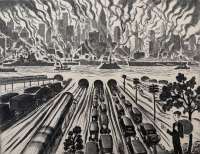 |
Big City
RALPH FABRI
American, (1894-1975)
Etching and drypoint, undated (circa 1940), edition 40. 7 x 9 in. Signed, numbered and titled in pencil. This is a superb impression of this very rare print. The margins are full and the condition is excellent. The Hungarian-born artist Ralph Fabri (1894-1975) studied as an architect before receiving his M.A. from the Royal Academy of Fine Arts in Budapest in 1918. He came to America in 1921 and was naturalized six years later, residing permanently in New York. Fabri became an active member of the art community, teaching at the Parsons School of Design in the late forties followed by the Newark School of Fine and Industrial Art and the National Academy School of Fine Arts. Concurrent with the latter position, he served as associate professor of art history at the City College, New York, until 1965. Fabri was active with the Artists for Victory project. (The biographical information above is by Lulen Walker of Georgetown University. They were gifted a substantial collection of his work.)
$1,500 |
|
 |
Arches
URSULA FOOKES
British, (1906-1991)
Linocut printed in colors, circa 1930, small edition. 9 1/4 x 6 3/4 in. Unsigned. This is a fine impression printed on a thin oriental paper. The margins are full. The condition is fine.
"Fookes studied at the Grosvenor School of Modern Art from 1929 to 1931, under Claude Flight. She exhibited in the annual British Linocut exhibitions at the Redfern and Ward Galleries in the 1930s, and also showed her work with the Society of Women Artists and the New English Art Club. Also during the 1930s Fookes painted and travelled abroad, often with the artist Pauline Logan, who shared a studio with her in Pimlico. In 1939, Fookes moved to Hampshire where she did war work before travelling to Europe in 1945 to spend a year running a mobile canteen for troops. The Imperial War Museum in London holds the diary she kept during that time. She retired to Wiveton in North Norfolk. In Norfolk she developed a keen interest in bird-watching and her output as an artist greatly diminished but interest in her work revived after her death. Examples of her work are held by the Art Institute of Chicago."
(biography courtesy of The Court Gallery website.)
$3,000 |
|
 |
Viaduct (also called Cloisters and Collonade)
URSULA FOOKES
British, (1906-1991)
Linocut printed in colors, circa 1930, from a small edition. 9 1/2 x 6 1/2 in. Unsigned. This is a fine impression printed on thin oriental paper. The sheet is mounted to a darkish gray support sheet which was done by the artist. The condition is fine. This stellar work is from the estate of the artist. Other works by Fookes are available.
$3,000 |
|
 |
Poplar Trees and Telephone Poles
URSULA FOOKES
British, (1906-1991)
Linocut printed in colors, circa 1930, from a small edition. 8 x 6 in. Unsigned. This is a fine impression of this nicely designed image. The paper is a thin oriental which is mounted to a dark gray support sheet. This was done by the artist.
The condition is fine. This impression is from the estate of the artist.
$3,000 |
|
 |
Mediterranean Village
URSULA FOOKES
British, (1906-1991)
Linocut printed in colors, circa 1930, from a small edition perhaps 50. 9 1/2 x 7 1/2 in. Unsigned. This is a superb, luminous impression printed on thin oriental paper. The margins are narrow and the condition is excellent. "Fookes studied at the Grosvenor School of Modern Art from 1929 to 1931, under Claude Flight. She exhibited in the annual British Linocut exhibitions at the Redfern and Ward Galleries in the 1930s, and also showed her work with the Society of Women Artists and the New English Art Club. Also during the 1930s Fookes painted and travelled abroad, often with the artist Pauline Logan, who shared a studio with her in Pimlico. In 1939, Fookes moved to Hampshire where she did war work before travelling to Europe in 1945 to spend a year running a mobile canteen for troops. The Imperial War Museum in London holds the diary she kept during that time. She retired to Wiveton in North Norfolk. In Norfolk she developed a keen interest in bird-watching and her output as an artist greatly diminished but interest in her work revived after her death. Examples of her work are held by the Art Institute of Chicago." (biography courtesy of The Court Gallery website.)
$3,000 |
|
 |
Spinning Wheel
WANDA GAG
American, (1893-1946)
Lithograph, 1927, Winnan 37, edition 100. 7 7/8 x 10 1/8 in. Signed in pencil. This is a fine impression printed on "BFK" (RIVES) watermarked paper. The margins are full and the condition is fine. This image was printed on a zinc plate by George Miller and the uncancelled plate is in the collection of the Philadelphia Museum of Art. In addition, there are two preliminary drawings in the same museum. Sixteen impressions are cited in museum collections.
$1,400 |
|
 |
The Venture
ELIZA D. GARDINER
American, (1871-1955)
Woodcut printed in colors, undated (circa 1920), Not listed in Falk/Newport Art Museum; edition 40. 12 1/2 x 8 1/2 in. Signed and numbered in pencil. Here we have a fine impresion of this rare print. The margins are full and the condition is very good. (There's a small area of darkening in the lower right corner of the image and two old paper hinges on the left and right edges, center.) There's an inscription in the bottom margin stating "The Venture $ 15; 40 in the edition; 30 duplicates." This large print is a fine example of her work. Gardiner became a pupil of painter Charles H. Woodbury (1864–1940), who likely introduced her to etching. It was as a woodcut printmaker, however, that Gardiner emerged, exhibiting in Europe and the United States beginning in 1910. She was influenced by the color woodcuts of innovative printmaker Arthur Wesley Dow and by the Japanese prints that had inspired him. SHe studied at the Rhode Island School of Design and later taught there for three decades.
$2,000 |
|
 |
Kestrel
WILLIAM GILES
British, (1872-1939)
Woodcut printed in colors , circa 1920-25, edition unknown buy probably small. 10 3/4 x 16 1/2 in. Initialed in the block, lower left. Signed in pencil and inscribed, "No.4." This is a superb impression of this extremely rare print. It's not included in the British Museum collection nor the V & A collection. We've never offered this print before and we have we seen only one appear at auction. Technically, Giles was amazing. He did a few pure woodcuts but he also eventually introduced zinc plate relief printing and they are difficult to tell apart. Both techniques are evident in many prints. He was inspired by Frank Morley Fletcher and William Blake. He became president of the Society of Graver Printers in Colour in the mid 1920's.
$3,000 |
|
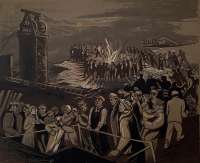 |
Mine Disaster
HARRY GOTTLIEB
American, (1894-1993)
Silkscreen printed in colors, circa 1939, from a small edition, perhaps 25. 16 3/4 x 20 in. Signed and titled in pen just below the image. This is a fine impression of this rare print. The margins are modest but they are comparable to the impression in the National Gallery in Washington, DC. The condition is good but there are a cople of cracks in the printed area from handling and a small tear extending to the image at the bottom edge. There are two pencil lines in the lower right corner in the brown blank
area. All things considered, the image is very nice. Gottlieb joined the Federal Art Project in New York in 1935 and he was one of the first members of the Silk Screen Unit. His work in this medium as well as in lithography is outstanding. There's a much more lightly printed impression in the Crystal Bridges Museum which contrasts with the night view in this impression.
$1,500 |
|
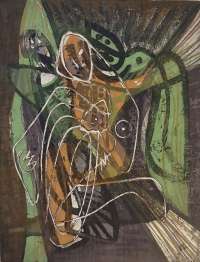 |
Palimpsest
STANLEY W. HAYTER
British, (1901-1988)
Zinc intaglio: sugar lift, soft ground etching and scorper with three silkscreens printed in color, 1946, Black/Moorehead 170, edition 30. 9 x 6 7/8 in. Signed and numbered in pencil. This is a fine impression printed on a sturdy wove paper. The margins are full and the condition is fine apart from small traces of printing ink above the image at right. "Palimpsest" was done in three states on a zinc plate: the first was with applied sugar-lift and soft ground, then soft ground texture in 1945; the second state had the textures rebitten in March of 1946; the third added 3 silkscreens and used the scorper to achieve the three dimensional elements. There were color trial proofs numbered 1 - 5. "A 'palimpsest' is a manuscript or piece of writing material on which the original writing has been effaced to make room for later writing but of which traces remain. Hayter builds layers of lines, colors, textures, and shapes overlapping each other; a dimensional white line, gouged out with a scorper, creates an abstracted figure on the surface of the colors." This quote comes from the Annex Galleries website.)
$2,500 |
|
 |
Suburban Evening
MARTIN LEWIS
American, (1881-1962)
Drypoint, 1925, McCarron 43, intended edition 40. 9 7/8 x 7 7/8 in. Signed in the plate, lower right corner. Signed in pencil. This is a superb impression of this rare print. The paper is a light cream wove with full margins. The condition is fine. Only 18 impressions were recorded. Impressions are found in the Detroit Institute of Arts and the New York Public Library.
SOLD |
|
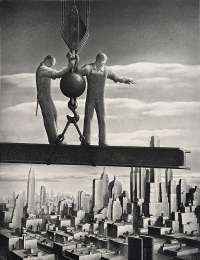 |
Builders of Bablyon
SAMUEL MARGOLIES
American , (1897-1974)
Etching and aquatint, 1937(?), AAA 1950.1113, edition 250. 14 1/4 x 11 in. Signed in pencil, lower right. Here we have a superb, luminous impression with wide margins. The condition is outstanding. This is a memorable and beautifully crafted image from the mid 20th century. This work, along with "Men of Steel," and "Man's Canyons", are his three finest prints. A native of Brooklyn, Margolies studied in New York at the Cooper Union Art School and the National Academy of Design. During the Great Depression of the 1930s, when many artists made prints in an effort to reach a wider audience through low-priced multiple artworks, Margolies turned seriously to etching. Working in a range of intaglio (or incised printmaking) techniques, he became a master of the tonal medium of aquatint. In 1935 Margolies joined the Federal Art Project of the Works Progress Administration (WPA), a Depression-era government relief program, and he served as an instructor in its Art Teaching Division.
SOLD |
|
 |
Two Arum Flowers
SAMUEL JESSURUN DE MESQUITA
Dutch, (1868-1944)
Lithograph, undated (possibly circa 1920), No in van Es, edition 25. 11 3/8 x 9 3/8 in. Signed and numbered in pencil. This is a fine impression of this very rare and unrecorded print. The margins are full and the condition is fine. Mesquita produced a few floral lithographs around 1920. This lovely image is simple in design yet it makes a powerful statement. (The vertical line in the background at left appears to be simply a scratch in the lithographic stone.)
SOLD |
|
 |
Bladbegonia
SAMUEL JESSURUN DE MESQUITA
Dutch, (1868-1944)
Lithograph printed on light tan paper, 1920, Van Es L038, only two impressions known by van Es. 9 3/4 x 11 1/8 in. Signed and dated in pencil. This is a fine impression of this very rare print. The margins are trimmed to just outside the image, certainly by the artist. The condition is excellent. This beautifully designed work has a modernist quality to it.
SOLD |
|
 |
Fantasy Group
SAMUEL JESSURUN DE MESQUITA
Dutch, (1868-1944)
Etching printed as a counterproof, circa 1925, Van Es D 116, Van Es cites 6 known impressions, two of which are counterproofs. 6 3/4 x 12 7/8 in. Signed in pencil, lower right. This is a fine, richly inked impression with the margins trimmed to just outside of the image (by the artist.) The condition is fine. This is one of many "sensitivic" etchings created by the artist. They are unique in so many ways and were done largely to entertain the artist. This is a fine example.
$1,400 |
|
 |
Fantasy; Five Figures
SAMUEL JESSURUN DE MESQUITA
Dutch, (1868-1944)
Drypoint, 1923, Van Es D 095; edition 12. Van Es has traced only 2 impressions. 8 x 9 1/8 in. Signed and numbered in pencil. This is a fine, rich impression with full margins. The condition is excellent. This is a stellar example of the artist's "sensitivic" style where he created fantaasy images with caricatures of people for his own enjoyment.
These prints are unique in the history of Dutch art and represent a major aspect of Mesquita's graphic work.
$1,500 |
|
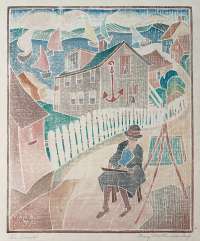 |
The Artist (Self Portrait) (Provincetown)
MARY MULLINEUX
American, (1875-1965)
White line color woodcut, circa 1925-35, edition unknown; extremely rare. 14 x 11 1/2 in. Initialed in the block, lower left. Signed and titled "The Artist" in pencil. This is a superb impression with full margins. The condition is very good overall apart from slight light toning within an earlier mat opening and occasional foxing in the margins, primarily well away from the image. Mullineux studied at the Pennsylvania Academy of Fine Arts from 1894 to 1900 and later between 1908 to 1908. She studied with William Merritt Chase and Cecila Beaux. When she spent her summers on the Cape including at Cape Ann and of course, Provincetown, she ultimately studied with Blanche Lazzell. The only other impression of "The Artist" which we've located is in the Smithsonian American Art Museum and their impression appears to be unsigned. Their impression was loaned to Janet Flint's show and catalogue, "A Woodcut Tradition; Provincetown Printers" (1983), page 40. The entry for this print lists the title as "Self Portrait." The provenance of our impression is Hirschl & Adler Galleries, New York then to a Boston area collector.
SOLD |
|
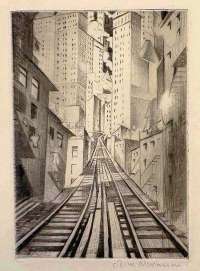 |
New York, An Abstraction
CHRISTOPHER R.W. NEVINSON
British, (1889-1946))
Drypoint, 1921, Black 77, Leicester Galleries 42; from a very small edition. 5 x 3 1/2 in. Signed in pencil and titled in pencil on the verso at the bottom. This is a fine impression printed on off-white laid paper bearing the watermark ENGLAND. The margins are full and the condition is fine apart from a faint suggestion of light toning within an earlier mat opening. One impression is located in the Metropolitan Museum of Art. Here we quote their comments from the Met's website entry: "In New York: An Abstraction", Nevinson effects a forward-facing view from a train rapidly moving through a valley of skyscrapers and tenement buildings as if it were cutting through the city itself. Shafts of light and shadows create multiple planes, which Nevinson compresses into a narrow, claustrophobic space. Nevinson omits the train itself, but creates the impression that the viewer is on a rollercoaster as it navigates what is likely part of the Third Avenue El, the elevated train." Nevinson also produced a 1920 oil painting of this same subject which is now in the Tate Gallery, London. Ex-collection: Osborne Samuel, London.
SOLD |
|
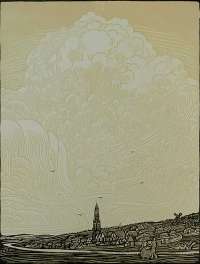 |
Rhenen
WOJ NIEUWENKAMP
Dutch, (1874-1950)
Woodcut printed in colors, 1911, Braches H74, Nieuwenkamp H74; edition unknown. 8 x 6 1/8 in. Signed and titled in pencil and with the pencil reference H 74. This is a superb impression of this outstanding small woodcut. The margins are apparently full and the condition is excellent. Rhenen is a city in the central Netherlands and it's famous church, Cunera Church, is prominent in this viewpoint. This print is illustrated on the cover of J.F.K. Kits Nieuwenkamp's book about the artist published in 1997.
$800 |
|
 |
Swans
MARGARET PATTERSON
American, (1867-1950)
Woodcut printed in colors, 1915-20, Not listed in Bakker's two catalogues; edition unknown. 7 3/8 x 10 1/4 in. Signed in pencil, lower right. Here we have a fine impression with rich colors. The sheet is trimmed to the borderline as is usually the case, certainly done by the artist. The condition is fine apart from a couple of very subtle printing creases showing at certain angles within in the image. This is a rare print.
$4,500 |
|
