|
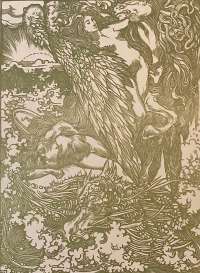 |
Perseus and Andromeda
JOHANNES AARTS
Dutch, (1871-1934)
Woodcut, circa 1905, Wielick H77, edition unknown. 9 3/8 x 7 in. Signed in the block with the monogram, lower left. Signed in pencil. This is a very good impression of this rare print. The margins are wide and the condition is fine. We believe this woodcut shows the story of Perseus and Andromeda. Perhaps Aarts showed the head of Medusa and Pegasus just to combine the most important images of the Perseus cycle. In other depictions of the story, Perseus and the head of Medusa are left out. Wielick catalogued this as Perseus and the Head of Medusa and the Rijksmuseum titles their impression as Perseus and Andromeda. Our website shows a similar print which we previously sold, Wielich H-75, titled as Perseus with the Head of Medusa. Aarts was born in the Hague and moved to Amsterdam in 1911 were he became an influencial teacher at the Rijksacademie. (He replaced Pieter Dupont who died prematurely in 1911.)
SOLD |
|
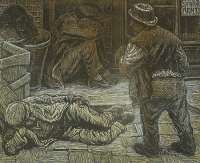 |
Leisure
ALBERT ABRAMOVITZ
Latvian-American, (1879-1963)
Woodcut (linocut?) printed in colors, circa 1937, edition probably about 25 impressions. 13 7/8 x 17 in. Initialed in the block and signed and titled in pencil. This is a fine impression of this large, rare print. Printed on a thin Japanese paper, the margins are full and the condition is very good. (There's a trace of wrinkling in the lower margin just to the image.) Abramovitz was born in Riga, Latvia, studied in Paris, and eventually settled in New York where he was employed by the WPA program. His work is illustrated and discussed in The Federal Art Project: American Prints from the 1930s (1985), published by the University of Michigan Museum of Art. His prints are in the following American collections: Art Institute of Chicago, Baltimore Museum of Art, Newark Museum, Philadelphia Museum of Art and others. This potent, expressionist image is an outstanding example of his work and a bold social statement about life for many during the 1930s.
SOLD |
|
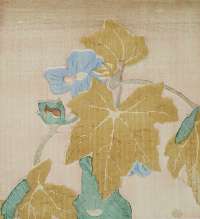 |
Mallow
ANDERS ALDRIN
American, (1889-1970)
Woodcut printed in colors, circa 1935, Newark Museum-Aldrin 2; total edition unknown but small. 6 1/2 x 6 in. Signed with the printed monogram in the lower right. Signed and titled in pencil. This is a fine impression with full margins. Fine condition apart from traces of previous hinges at the top corners. This is one of a few color variants of this image printed by the artist. Aldrin was born in Sweden and moved to America in 1911. By 1920, Aldrin had relocated to southern California and studied at the Otis Art Institute. He later attended the Santa Barbara School of Art and studied with Frank Morley Fletcher, the British artist known for his exceptional woodcuts in the Japanese manner. Provenance: Annex Galleries, CA.
$1,200 |
|
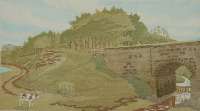 |
The Trees of the Standing Stones, Dunstaffnge
ANN D. ALEXANDER
Scottish, (b. 1890)
Woodcut printed in colors, 1936, edition 50. 7 1/2 x 13 1/2 in. Signed, titled and dated in pencil. A fine impression on thin Japanese paper. Full margins. Very good condition. (Small color specks in the sky; faint discoloration within the previous mat opening.)
SOLD |
|
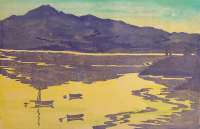 |
Summer Dawn - Loch Etive-Side
ANN D. ALEXANDER
Scottish, (b. 1890)
Woodcut printed in colors, 1932, edition unknown (probably 50). 6 1/2 x 10 in. Signed, dated and titled in pencil. This is a fine impression on Japanese paper. The margins are fine and the condition is very good. (There's slight minor toning within an earlier mat opening.) Loch Etive joins the sea between the villages of Connel and Dunstaffnage. Ex-collection: Robert O. Muller.
$1,100 |
|
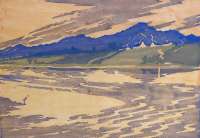 |
Summer Afterglow, Loch Etive-side IV
ANN D. ALEXANDER
Scottish, (b. 1890)
Woodcut printed in colors, 1933, edition probably 50. 7 x 10 in. Signed, dated and titled in pencil. This is a very fine impression with full margins. The condition is fine apart frame a very faint suggestion of toning within an early mat opening. The artist studied at the Glasgow School of Art and exhibited extensively between 1917 and 1940. Ex-collection: Robert O Muller.
$1,100 |
|
 |
Composition in Red and Green
WOBBE ALKEMA
Dutch, (1900-1984)
Linoleum cut, 1926-1978, Bool / Peterson G 34, edition 75. 7 1/4 x 5 3/8 in. Signed and numbered in pencil. This is a fine impression with full margins. The condition is also fine apart from a few soft handling creases in the outer margins. This is from the second edition of 75 printed in 1978 and is so numbered "26/78." The very early impressions are impossible to find as they were proofs only. Alkema was originally trained as a cabinetmaker and he eventually worked with an architectural firm in Groningen. He joined De Ploeg and produced many remarkable works of geometric abstraction in painting as well as printmaking. His paintings from the 1920s are important today and his prints are equally desirable. Alkema was also associated with the Belgian Constructivists including Jozef Peeters and the writer, Paul van Ostaijen. Alkema was a member of de Ploeg for only a year or so. He had two exhibitions in 1978; one at the Stedelijk and the other at the Gemeentemuseum in the Hague. Furthermore, the Groninger Museum had an exhibition and published a major book on the artist in 2009. This work is illustrated on page 96, also from the later edition done in 1978.
$1,800 |
|
 |
Geometric Composition (Geometrische Compositie)
WOBBE ALKEMA
Dutch, (1900-1984)
Linocut, 1924, Bool/Petersen G24, from a small edition. 7 3/4 x 4 1/2 in. Signed and dated in pencil. This is a fine impression printed in black and yellow ochre. The margins are full apart from a loss in the upper left corner. The condition is very good. There are signs of old wrinkles, small repairs at the edges of the sheet, top and bottom edges, and traces of paint loss of the black showing here and there in the image. This print is exceedingly rare being both signed and printed in more than one color. An impression similar to this one is in the Stedelik Museum ("een aafdruk op okergeel papier").This work is illustrated in the black and white version in the following, Wobbe Alkema, The Absolute, The Bright, published by the Groninger Museum in 2009. Authors include Doeke Sijens and Sjoerd van Faassen. (See page 80.)
This impression is dedicated to Jan van der Zee in pencil along the bottom left. They were both prominent members of the Ploeg movement.
SOLD |
|
 |
Composition in Red and Black
WOBBE ALKEMA
Dutch, (1900-1984)
Woodcut printed in colors, 1925, Bool / Petersen G31, edition 40. 6 x 3 7/8 in. Signed, dated and numbered in pencil. This is a fine impression printed on very smooth wove paper. The margins are full. The condition is very good apart from slight light toning within a previous mat opening. This important woodcut is from the 1976 edition of 40 impresssions printed by Emile Puettmann for the deluxe edition of "Wobbe Alkema, Lino et Houtsneden 1923-1927." Early impressions of Alkema woodcuts are exceedingly rare as they were not formally editioned. This print is featured on the cover of Adriaan Venema's landmark book, "De Ploeg 1918-1930,"(1978). Alkema was originally trained as a cabinetmaker and he eventually worked with an architectural firm in Groningen. He joined De Ploeg and produced many remarkable works of geometric abstraction in painting as well as printmaking. His paintings from the 1920s are important today and his prints are equally desirable. Alkema was also associated with the Belgian Constructivists including Jozef Peeters and the writer, Paul van Ostaijen.
$2,800 |
|
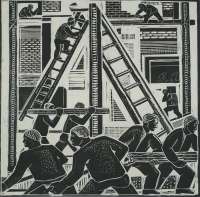 |
Bouwen (Building)
PETER ALMA
Dutch, (1886-1969)
Linocut, 1926, edition unknown. 16 1/4 x 16 5/8 in. Signed and dated in the block, upper left corner. Signed and titled in pencil and also inscribed "No.2". This is a fine impression printed on heavy laid paper with wide margins. The condition is fine. This large, early work by Alma epitomizes his interest in workers and their rights. This is, in many ways, a Dutch equivalent to the American WPA print with all its connotations. Alma studied in the Hague and moved to Paris when he was only twenty. There he met Mondrian and Lodewijk Schelfhout who shared a studio. He studied in Paris at the Académie Humbert (1907-1914). Alma was greatly influenced by the Russian Revolution having joined the Communist Party in 1919 and then visiting Moscow in 1921. There he met with Kandinsky, El Lissitsky, and others. A major retrospective of his work was held at the Stedelijk Museum in 1960. This museum was also the home of his first retrospective held in 1924.
SOLD |
|
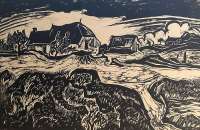 |
Landscape with Farmhouses
JAN ALTINK
Dutch, (1885-1971)
Woodcut, 1926, edition unknown. 9 3/8 x 14 3/4 in. Signed and dated in ink, lower right. Here we have a fine, rich impression printed on a sturdy cream wove paper. The margins are full and the condition is good. (There's a repaired break just outside the image in the upper left corner. There are traces of old cellotape adhesive in the margins, one of which extends on the bottom to just outside the image.) This potent and very rare woodcut exemplfies Altink at his best in this medium. He also worked in etching and lithography and excelled as a painter. He was born in Groningen and studied at the Minerva Academy. He one of the founders of "de Ploeg" and remained a member of the group into the 1960s.
SOLD |
|
 |
In Full Cry
SYBIL ANDREWS
British/Canadian, (1898-1992)
Linocut printed in colors, 1931, Coppel SA 13, White 13; edition 50. 11 1/4 x 16 1/2 in. (image); 12 7/8 x 171/2 in. (sheet) Signed, numbered "40/50," and titled in pencil. This is a superb impression printed on thin gampi paper (Japanese). The margins are full and the condition is fine. (There are a few subtle reinforced breaks and thin spots in the extreme edges of the sheet, not affecting the image.) This large and dynamic work depicts a fox hunting scene and is a masterpiece of Grosvenor School linocut printmaking. Provenance: Osborne Samuel, London; private collection, Massachusetts. (The print is beautifully framed and this is included in the price.)
SOLD |
|
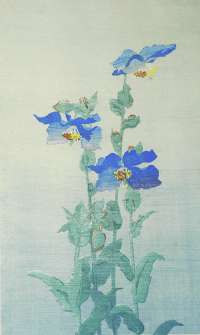 |
Blue Poppies
JEAN ARMITAGE
British, (exhibited 1919-1938)
Woodcut printed in colors, circa 1930, edition 50. 12 7/8 x 7 3/4 in. Signed, titled and numbered in pencil. This is a superb impression with full margins. The condition is fine other than for a soft wrinkle here and there, primarily in the margins. The influence of Japanese printmaking is here in evidence. Her work is executed with great skill, especially as seen here. She studied with the illustrator J.D. Batten at the Byam Shaw School of Art and exhibited with the Royal Institute of Painters in Water Colours. This information was provided by the British Museum and they own two example of her woodcuts.
SOLD |
|
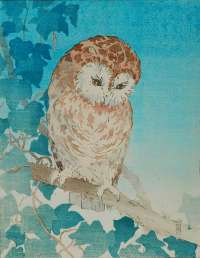 |
The Tawny Owl
JEAN ARMITAGE
British, (exhibited 1919-1938)
Woodcut printed in colors, circa 1925, edition 50. 10 3/8 x 8 in. Signed, numbered and titled in pencil. Here we have a fine, luminous impression with full margins. The condition is fine apart from old hinges at the top two corners, a small spot of foxing to the right of the image and a subtle little repair in the lower left corner below the title. The influence of Japanese printmaking is here in evidence. Her work is executed with great skill, especially as seen here. She studied with the illustrator J.D. Batten at the Byam Shaw School of Art and exhibited with the Royal Institute of Painters in Water Colours. This information was provided by the British Museum and they own two example of her woodcuts.
SOLD |
|
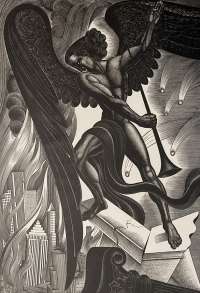 |
The Last Trumpet
BORIS ARTZYBASHEFF
Russian/ American, (1899-1965)
Wood engraving, 1937, edition 200. 11 3/8 x 7 7/8 in. Signed and titled in pencil. This is a fine impression printed on a cream wove paper. The margins are full. The condition is very good apart from old adhesive on the top corners, verso, where the sheet was attached to the accompanying portfolio. This potent image was published by the Woodcut Society of Kansas City with an introduction by Carl Carmer. Artzybasheff was a gifted set designer and illustrator and he created more than 200 covers for Time magazine before his death. This potent image was perhaps partially inspired by his early time in the front lineswhen the Russian Revolution broke out in 1917. He was drafted into the German sponsored Ukranian army and was forced to fight for a separatist Ukranian Republic. With his life at risk, he eventually escaped and made it to New York and commenced his career as an artist. This is a universal statement about war and destruction against the background of a large metropolis.
$3,500 |
|
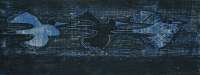 |
Three Birds
MILTON AVERY
American, (1893-1965)
Woodcut printed in blue and black, 1952, Lunn 43ii, edition of 15. 9 1/2 x 25 in. Signed, dated and numbered in pencil. This is a superb, luminous impression printed on Japanese paper. The margins are probably full and untrimmed. The condition is generally fine. (There's some stray printers ink in the margins which is not uncommon with Avery's woodcuts.) This captivating, large work is one of his finest prints done in the woodcut medium, particularly in this color combination. (There were also fifteen impressions in black and twenty in yellow and black.) Avery loved depicting whimsical birds as subject and there are paintings that relate to this image. Avery was introduced to the medium by fellow artist, Steve Pace. He printed his own blocks, sometimes with the assistance of his wife and daughter.
SOLD |
|
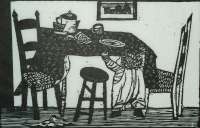 |
Child Reaching
WILL BARNET
American, (1911-2012)
Woodcut, 1940, Cole 82, Szoke 83; edition 25 (60) 7 1/8 x 11 1/4 in. Signed, titled and numbered in pencil. This is a fine dark impression printed on thin japanese paper. The margins are full. The condition is fine other than for slight handling marks on the left and right edges of the paper. This charming work was printed and published by the artist. This impression is numbered 59/60. There's no indication in either catalogue raisonné that a second edition was printed. Most likely the artist printed 35 more impressions and continued the numbering as we see here.
$850 |
|
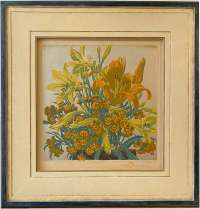 |
From Hillside Gardens
GUSTAVE BAUMANN
American, (1881-1971)
Woodcut printed in colors, 1941-46, Chamberlain 162, edition 83. 12 3/4 x 12 5/8 in. Signed, numbered and titled in pencil. This is a fine, vibrant impression of the second of two printings. The margins are wide. The condition is fine apart from an exceedingly faintsuggestion of toning in the outer margins. The first printing (1941) was generally with a silver leaf background and here in the second printing (1946), the background color is silver ink. The inspiration for this lovely print was a garden at Hillside, Lydia Coonley Ward's home in Wyoming, New York. (Note: This is a Baumann replica frame of exceptional quality. We had it made up for this print.)
ON HOLD |
|
 |
La Loma (Taos)
GUSTAVE BAUMANN
American, (1881-1971)
Woodcut printed in colors, 1919-1931, Chamberlain 62, from a projected edition of 100. 9 1/2 x 11 1/4 in. Signed, titled and numbered "28/100" in pencil and with the hand in heart chop mark. This is a superb impression with full margins. The condition is excellent. There is no apparent watermark. According to the catalogue, "Impressions inscribed "26/100" and higher are quite different from earlier impressions. An impression inscribed "51/100" in the New Mexico Museum of Art (Plate 62.2) has the addition of black, which lends brilliance and clarity to the scene." Our impression is quite similar to the one in this Museum and was evidently printed in 1931. The highest known numbered impression is "65/100". (Note: The La Loma Plaza Historic District is an old neighborhood in Taos, New Mexico that was listed with the National Register of Historic Places in 1982.)
$14,000 |
|
 |
The Kiss (Der Kuss)
PETER BEHRENS
German, (1868-1940)
Woodcut printed in colors, 1898-1900, edition unknown. 7 1/2 x 6 in. Initialed in the block, lower center. Signed with the printed text, lower left, below the image. This is a fine impression with full margins. The condition is very good apart from light toning to the sheet. This memorable image first appeared in PAN (Volume IV/1898, issue two.) The present, slightly reduced version, appeared in Die Kunst, Volume 2, Munich, in 1900. Behrens was a leading German architect, graphic and industrial designer. He had a long career designing objects, typefaces and important buildings in a range of styles from around 1900 to the 1930s. This is his best known print.
$1,300 |
|
